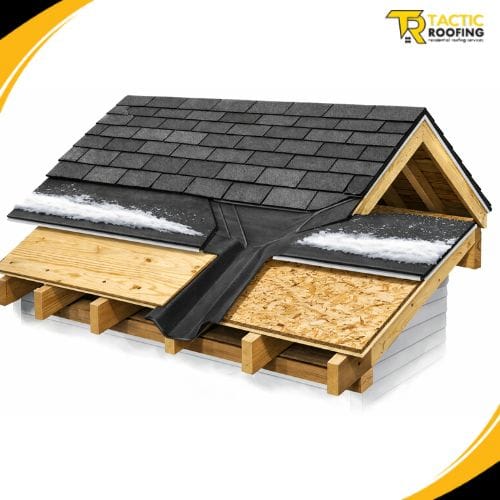
Ask most homeowners what protects their roof, and they’ll point to shingles. Ask a roofer what actually saves a roof from catastrophic leaks, and the answer is far less visible. In Canada—especially in Ontario—the most critical defense against water intrusion often lies beneath the shingles: ice and water shield Ontario contractors rely on to stop leaks before they start.
Despite its importance, ice and water shield is one of the most misunderstood components of the modern roofing system. It’s frequently overused, underused, or installed incorrectly. Some homeowners assume it’s only for winter. Others think covering the entire roof with it is “extra protection.” Both assumptions can shorten roof life and create moisture problems.
This article explains what ice and water shield really does, where it should be installed, common installation errors, and how it works with other roof underlayment layers and flashing details to protect the entire roof system.
What Ice & Water Shield Actually Is (and Isn’t)
Ice and water shield is a self-adhering, peel and stick underlayment designed to form a watertight seal directly to the roof deck. Unlike traditional felt or synthetic underlayments, it bonds to the wood substrate and seals tightly around nails and fasteners.
At its core, it is a leak barrier membrane, not a general-purpose underlayment.
What it does:
-
Stops water that gets under shingles from reaching the decking
-
Seals around fasteners and penetrations
-
Provides localized protection in high-risk areas
What it does not do:
-
Replace proper roof ventilation
-
Compensate for poor flashing design
-
Eliminate the need for other underlayment layers
-
Make a poorly built roof “leak-proof”
Understanding this distinction is essential to using it correctly.
Why Ice & Water Shield Matters So Much in Ontario
Ontario’s climate creates unique roofing challenges. Homes face:
-
Freeze–thaw cycles
-
Wind-driven rain
-
Snow accumulation followed by melt
-
Ice buildup at roof edges and valleys
Water doesn’t just fall straight down. It’s pushed sideways by wind, drawn upward by capillary action, and trapped by ice. When that happens, shingles alone are not enough.
The National Research Council of Canada has noted that water intrusion in roofs often occurs “when moisture is driven under the roofing assembly by wind, ice accumulation, or capillary forces.” This is precisely the condition ice and water shield is designed to handle.
Where Ice & Water Shield Should Be Installed
One of the biggest mistakes in roofing is assuming ice and water shield belongs everywhere. In reality, its effectiveness depends entirely on where it’s used.
1. Eaves (The Most Critical Location)
Eaves are the number one priority for ice and water shield in Ontario.
Why?
-
They overhang unheated exterior walls
-
Snow melts higher on the roof and refreezes here
-
Water backs up under shingles during ice formation
Proper eaves protection means installing ice and water shield from the roof edge upward to at least 24 inches inside the warm wall line (often more, depending on overhang depth).
This is not optional. Ontario Building Code requirements reflect this risk.
2. Valleys
Roof valleys concentrate water flow. Even a small obstruction or heavy rain event can overwhelm shingles in these areas.
Ice and water shield in valleys:
-
Protects against high-volume runoff
-
Seals nail penetrations under valley flashing
-
Reduces risk from debris buildup
Valleys are one of the most common leak locations on otherwise “new” roofs.
3. Roof Penetrations
Any penetration through the roof deck is a risk point:
-
Plumbing vents
-
Chimneys
-
Skylights
-
Mechanical curbs
Ice and water shield should wrap these areas before flashing is installed. This creates a secondary waterproof layer beneath the metal or rubber flashing system.
As Building Science Corporation has stated, “Redundancy at roof penetrations is critical because primary seals are expected to fail over time.” Ice and water shield provides that redundancy.
Where Ice & Water Shield Should Not Be Installed
More is not always better.
Covering the entire roof deck with ice and water shield can:
-
Trap moisture in the deck
-
Interfere with drying potential
-
Increase the risk of deck rot if ventilation is imperfect
Standard practice in Ontario is to use ice and water shield selectively, then transition to appropriate synthetic or felt underlayment for the rest of the roof.
This layered approach is fundamental to proper roof underlayment layers design.
Common Installation Errors That Cause Problems
Ice and water shield failures are rarely material failures. They are installation failures.
Error 1: Installing Over Wet or Dirty Decking
The membrane must bond directly to clean, dry wood. Installing it over damp decking compromises adhesion and can create hidden moisture pockets.
Error 2: Incorrect Overlaps and Seams
Seams must be properly overlapped and rolled. Gaps or fish-mouths allow water to track underneath—defeating the purpose of the membrane.
Error 3: Poor Transitions to Other Underlayments
Where ice and water shield ends and other underlayments begin, the transition must shed water downward. Reverse laps create hidden leak paths.
Error 4: Cutting Instead of Wrapping Penetrations
Cutting around pipes instead of wrapping the membrane tightly around them creates weak points. Ice and water shield is meant to seal, not just sit nearby.
Error 5: Using It to “Fix” Design Problems
Ice and water shield is not a substitute for proper flashing, slope, or ventilation. Using it to mask design flaws often leads to bigger issues later.
How Ice & Water Shield Protects the Entire Roof System
When installed correctly, ice and water shield works in coordination with other components—not independently.
With Roof Flashing
In The Role of Roof Flashing in Leak Prevention, flashing is identified as the primary defense at transitions. Ice and water shield acts as the secondary defense underneath. If flashing fails, the membrane buys time and prevents immediate damage.
With Waterproofing Strategies
In The Ultimate Guide to Roof Waterproofing in Canada, layered protection is emphasized. Ice and water shield is one layer in a system that includes:
-
Proper underlayment selection
-
Correct shingle installation
-
Ventilation and insulation balance
No single layer works alone.
Ice & Water Shield vs Peel and Stick Underlayment
Not all peel-and-stick products are the same.
True ice and water shield:
-
Has higher rubberized asphalt content
-
Is designed to self-seal around nails
-
Remains flexible in cold temperatures
Some peel-and-stick underlayments are meant for full-roof coverage in specific assemblies—but they are not all ice and water shields. Using the wrong product in the wrong location can cause performance issues.
What a Quality Roofing Contractor Checks Before Installation
Before installing ice and water shield, an experienced contractor evaluates:
-
Deck condition (rot, delamination, fastener pull-out)
-
Roof geometry and water flow paths
-
Overhang depth and wall alignment
-
Ventilation balance
-
Compatibility with chosen shingles and flashing
This assessment determines how much ice and water shield is needed and where it will be effective.
Blindly installing it without this analysis often leads to overuse or misplacement.
Why This Layer Is So Often Misunderstood
Ice and water shield is invisible once the roof is finished. Homeowners rarely see it, and many contractors don’t explain it well. That leads to assumptions:
-
“More coverage equals more protection”
-
“It’s only for cold weather”
-
“It replaces proper flashing”
None of these are true.
In Ontario, ice and water shield is not a luxury upgrade—it’s a precision tool. Used correctly, it quietly prevents some of the most expensive roof failures. Used incorrectly, it creates moisture traps and false confidence.
Final Perspective: Precision Beats Excess
Ice and water shield is one of the most powerful components in modern Canadian roofing—but only when it’s used intentionally. Strategic placement at eaves, valleys, and penetrations protects the roof where failure is most likely, without compromising the system’s ability to dry and breathe.
Understanding ice and water shield Ontario standards helps homeowners ask better questions, recognize quality workmanship, and avoid costly mistakes hidden beneath the shingles.
What protects your roof most isn’t what you see—it’s how the invisible layers are designed to work together.